Defense & Guard Operations

A structural overview of U.S. military and contractor-operated remotely piloted aircraft (RPA) ecosystems.
Remote Warrior Founder - Tanner Yackley - Discusses what Remote Warfare is actually like w/ Business Insider
1. Scope
This page provides:
A high-level explanation of how U.S. RPA operations are structured
Major defense contractors in the remotely piloted aircraft space
Guard-operated MQ-9 locations (starter reference list)
Basic organizational architecture
It does not provide operational details, tactics, sortie data, or sensitive base-level information.
2. What Are Defense RPAs?
Remotely Piloted Aircraft (RPA) are military-operated unmanned aircraft systems used for:
Intelligence, surveillance, and reconnaissance (ISR)
Strike operations (when authorized)
Border and maritime monitoring
Persistent overwatch
Unlike small commercial drones, defense RPAs operate within:
Formal command chains
Classified tasking systems
Integrated airspace structures
3. How Operations Are Structured (High-Level)
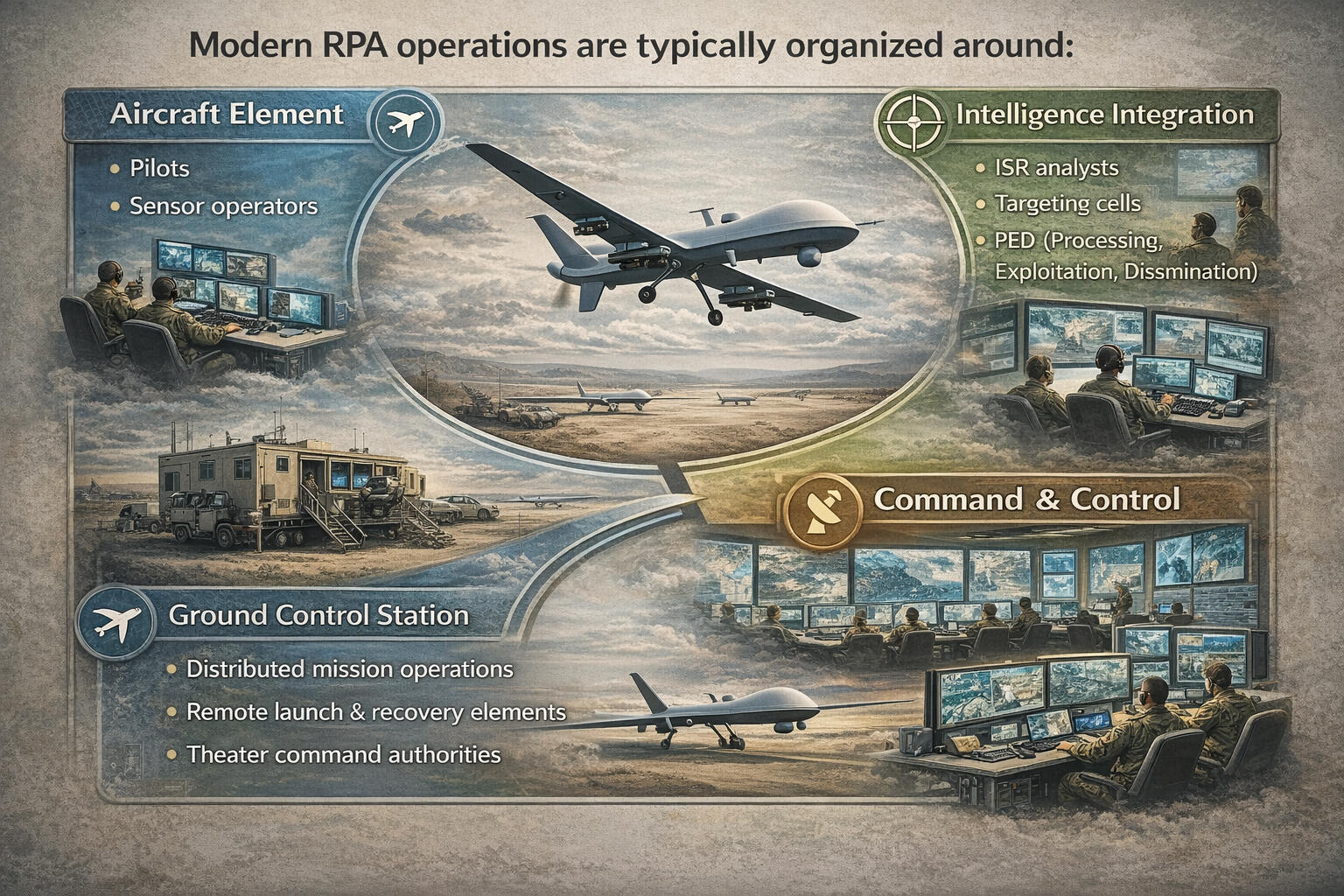
Modern RPA operations are typically organized around:
Aircraft Element
Pilots
Sensor operators
Intelligence Integration
ISR analysts
Targeting cells
PED (Processing, Exploitation, Dissemination)
Command & Control
Distributed mission operations
Remote launch & recovery elements
Theater command authorities
Operations are frequently geographically distributed, with aircraft in one region and crews in another.
4. Major Defense Prime Contractors (RPA Space)
(Non-exhaustive; listed without ranking.)
Aircraft Manufacturers
Systems Integration & ISR Support
These companies provide aircraft, sensor systems, ground control stations, integration, and sustainment support.
5. MQ-9 Guard Operations (Starter Reference List)
Air National Guard units operate MQ-9 aircraft in several states.
This is a non-sensitive, publicly known overview and not a full list.
Examples include:
North Dakota ANG (119th Wing)
New York ANG (174th Attack Wing)
Texas ANG (147th Attack Wing)
Nevada ANG (147th Reconnaissance Wing legacy involvement)
California ANG (163rd Attack Wing)
Iowa ANG (132nd Wing)
Ohio ANG (178th Wing)
Arizona ANG (214th Attack Group)
Unit missions and aircraft allocations change over time.
6. Active Duty RPA Locations (Public Reference)
Primary U.S. Air Force RPA bases include:
Creech AFB, NV
Holloman AFB, NM
Ellsworth AFB, SD
Whiteman AFB, MO
These installations support training, operational missions, and command elements.
7. Contracting & Civilian Roles
Defense RPA ecosystems include:
Aircraft maintenance contractors
Sensor integration engineers
Software developers
Intelligence support personnel
Logistics and sustainment specialists
Many contractor roles mirror military specialties in technical and analytical functions.
8. Guard vs Active Duty Distinctions
Guard Units
State-based
Federal mission when activated
Often embedded in local communities
Mixed full-time and traditional members
Active Duty Units
Full-time federal service
Centralized command structures
Formalized training pipelines
The distributed model allows persistent global coverage while crews may remain domestically based.
9. Structural Characteristics of Remote Operations

Key features of the defense RPA model:
Geographically separated crew and aircraft
Screen-mediated lethal authority (when applicable)
Shift-based operational tempo
Integrated intelligence architecture
Continuous mission cycles
Understanding the structure is more important than memorizing platform specifications.
10. Boundary Statement
This page provides a structural overview of defense and Guard RPA ecosystems.
It does not:
Provide tactical procedures
Analyze operational vulnerabilities
Offer mission data
Provide deployment patterns
Advocate recruitment
Contact:
[email protected]
All content and resources provided by Remote Warrior LLC are for informational and educational purposes only. Nothing on this site should be interpreted as legal, medical, or clinical advice, nor does it represent the official policy or position of the United States Department of Defense or U.S. Air Force. Use of any material is at your discretion and does not create a professional or therapeutic relationship. For questions related to health, safety, or legal matters, consult a qualified professional.
© 2026 Remote Warrior